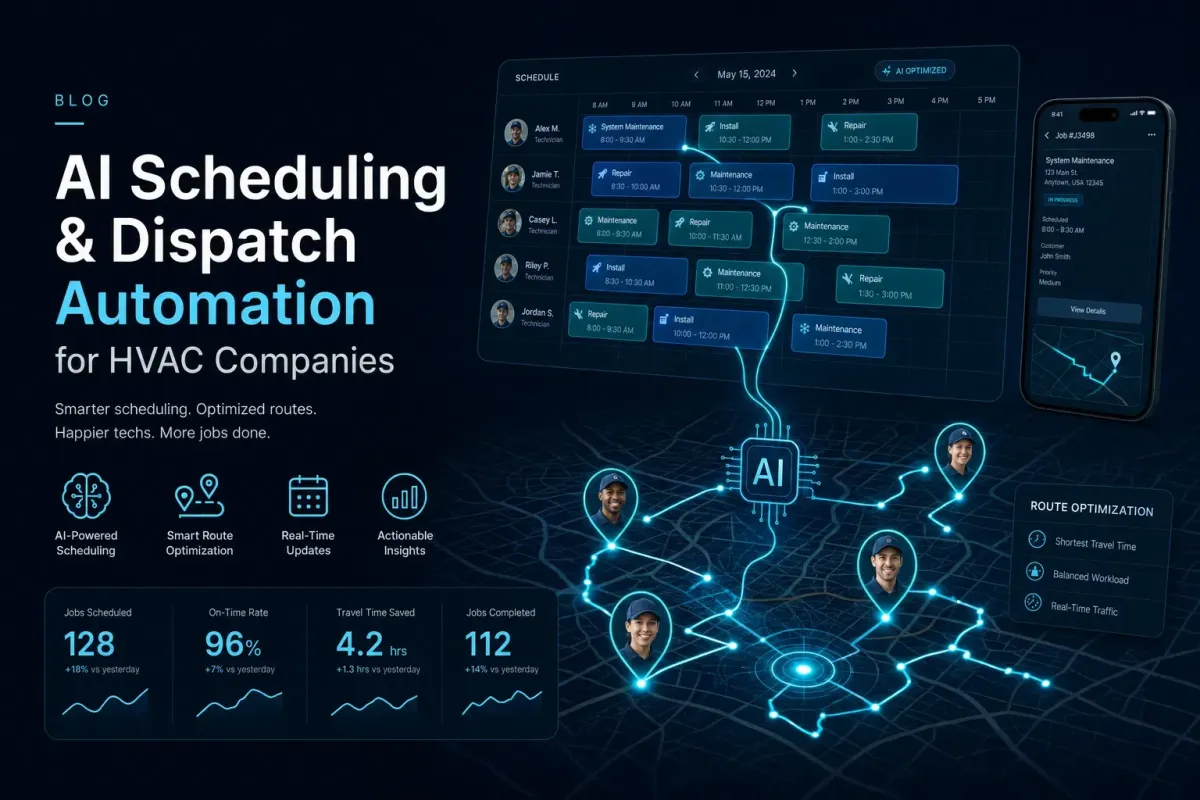
Can AI Automate My HVAC Scheduling and Dispatch?
Running an HVAC business means juggling a hundred moving parts at once — technicians, service calls, seasonal surges, emergency breakdowns, and customers who needed help "yesterday." If you've ever wondered whether artificial intelligence can take some of that chaos off your plate, the answer is a resounding yes. AI-powered scheduling and dispatch tools are transforming how HVAC companies operate — and the businesses adopting them early are pulling ahead fast.
The Scheduling Problem Every HVAC Owner Knows
Ask any HVAC dispatcher what their day looks like, and you'll hear the same story: phones ringing off the hook, a whiteboard covered in names and addresses, technicians texting about traffic, and customers calling back to ask where their tech is.
Traditional scheduling is reactive. A call comes in, you find an open slot, you send whoever's available. It works — barely — when the workload is manageable. But during peak seasons (hello, July heat waves and December cold snaps), "barely" turns into "barely surviving."
The real cost isn't just stress. It's wasted drive time, missed appointments, underutilized technicians, and customers who don't call back next year.
What AI Actually Does for Scheduling
AI scheduling tools don't just digitize your existing process — they fundamentally rethink it. Here's what they bring to the table:
Smart Job Assignment AI considers dozens of variables simultaneously: technician skill set, current location, traffic conditions, parts inventory, job history at the address, and customer priority tier. A human dispatcher might weigh two or three of these factors. AI weighs all of them in seconds.
Predictive Demand Forecasting AI systems can analyze years of your historical data — combined with weather forecasts and local patterns — to predict when your phones will light up. That means you can pre-schedule preventive maintenance calls during slow periods and staff up before demand peaks, rather than scrambling when it hits.
Automated Customer Communication From booking confirmations to technician ETAs to follow-up surveys, AI can handle the entire customer communication chain automatically. Customers get texts or emails when their tech is 30 minutes out, reducing "where is my tech?" calls by as much as 60% for some companies.
Dynamic Re-Routing When a job runs long, a tech gets stuck in traffic, or an emergency call comes in, AI can instantly re-optimize the entire day's schedule — reassigning jobs, notifying customers, and rerouting technicians without a dispatcher having to manually untangle everything.
Real Dispatch Intelligence: Beyond the Whiteboard
Modern AI dispatch platforms connect to your CRM, GPS fleet tracking, and parts inventory in real time. This creates a live operational picture that no whiteboard can match.
Imagine this: A tech finishes a job 45 minutes early. The AI detects this, checks nearby open slots in the schedule, identifies a customer in the area who's been waiting two days for a callback, confirms the tech has the required parts on the truck, and reassigns the job — all before the tech has even started their van.
That's not science fiction. That's what tools like ServiceTitan AI, Samsara, and FieldEdge are delivering to HVAC companies right now.
Is AI Right for Your HVAC Business?
AI scheduling pays the biggest dividends for businesses that:
Run 5+ technicians — the optimization gains compound with fleet size
Handle a high volume of service calls — the more jobs per day, the more efficiency AI can unlock
Struggle with seasonal demand swings — predictive tools shine here
Want to reduce dispatcher burnout — AI handles the repetitive coordination work
Smaller owner-operator shops may find that a simpler digital scheduling tool serves them just fine. But if you're growing — or want to grow — AI-backed dispatch is worth a serious look.
The Transition: What to Expect
Adopting AI dispatch isn't a flip-a-switch moment. Expect a ramp-up period of 4–8 weeks as the system learns your workflows, your technicians' habits, and your customer base. Staff buy-in matters — technicians who understand the system work with it rather than around it.
Most HVAC operators who make the switch report that within 90 days, they see measurable improvements in jobs completed per tech per day, reduced drive time, and higher customer satisfaction scores.
The Bottom Line
AI won't replace your best dispatcher or your most skilled technician. What it will do is give them superpowers — eliminating the tedious, error-prone coordination work so they can focus on what actually requires human judgment.
In an industry where margins are tight and customer loyalty is won or lost on responsiveness, the HVAC companies that automate their scheduling and dispatch intelligently won't just work more efficiently. They'll win more business, retain more customers, and scale without proportionally growing their overhead.
The technology is here. The question is whether you're ready to use it.
Thinking about implementing AI dispatch for your HVAC business? Start by auditing your current scheduling bottlenecks — the answer to where AI helps most is usually hiding in plain sight.
Precision Automation Solutions builds and manages AI-powered lead conversion and lead generation systems for HVAC companies nation-wide. Setup takes 72 hours. You handle your customers — we handle everything else.
