How Can AI Predict When HVAC Customers Need Service?
The future of HVAC isn't just about fixing problems — it's about preventing them before they happen.
Every HVAC contractor has heard some version of the same story: a homeowner calls in a panic because their AC stopped working on the hottest day of the year, or a business owner's heating system fails overnight in January. These aren't just uncomfortable situations — they're expensive emergencies that could have been avoided. Artificial intelligence is changing that dynamic, giving HVAC companies the ability to anticipate service needs before a breakdown ever occurs. Here's how it works and why it matters for your business.
The Problem with "If It Ain't Broke, Don't Fix It"
Traditionally, HVAC service has been reactive. Customers call when something breaks, and technicians arrive to diagnose and repair the issue. Some companies upgraded to scheduled preventive maintenance — seasonal tune-ups on a calendar basis — which was a step forward but still imprecise. A system that's running perfectly in September doesn't necessarily need the same attention as one that's been laboring through record heat all summer.
The limitation of both approaches is the same: they rely on time or failure, not on the actual condition of the equipment. AI flips that model entirely.
How AI Collects and Reads the Data
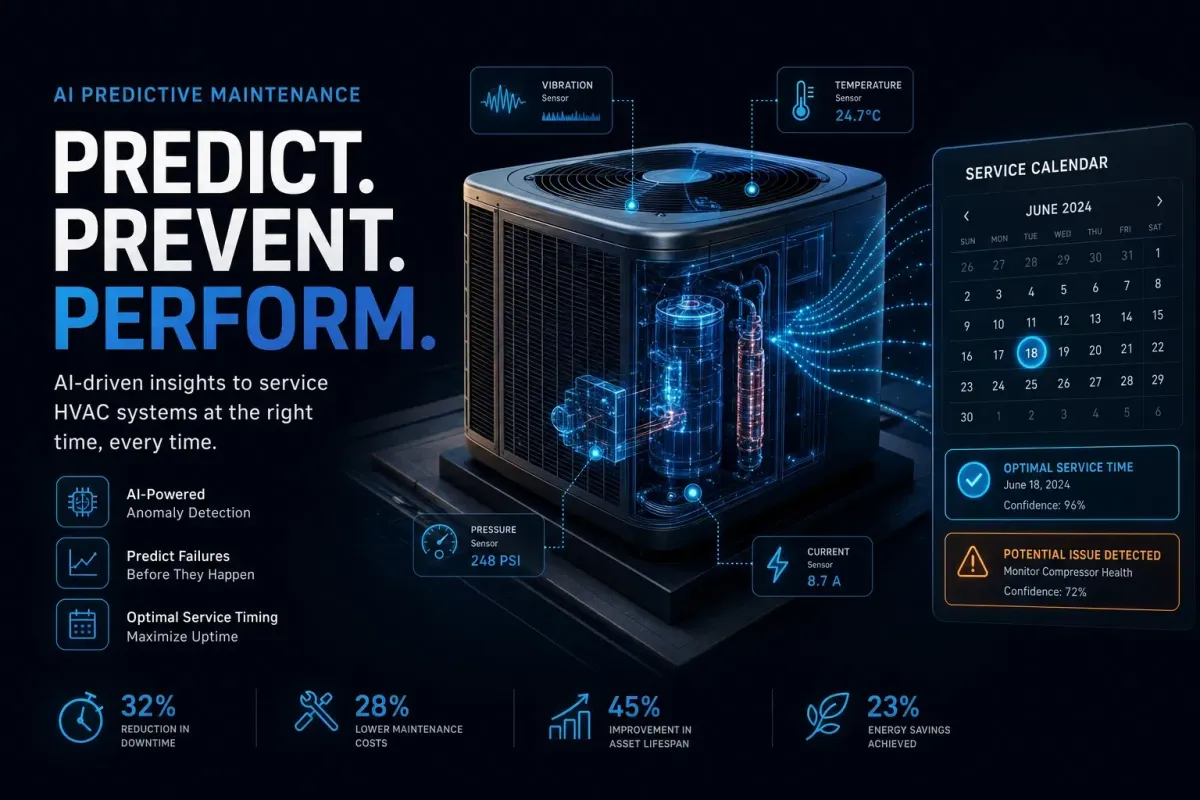
Modern HVAC systems — and increasingly, even older ones retrofitted with smart sensors — generate a constant stream of data. This includes temperature differentials across coils, refrigerant pressure levels, compressor cycling frequency, airflow rates, motor amp draws, and runtime hours. On their own, these numbers are hard to interpret. Feeding them into a machine learning model is where the magic begins.
AI systems are trained on enormous datasets of HVAC performance histories, learning what "normal" looks like for a given unit type, age, climate zone, and usage pattern. Once that baseline is established, the model continuously monitors live data and flags deviations — not just major ones, but subtle drifts that the human eye would never catch.
For example, if a compressor's amp draw has been trending upward by a small margin over 60 days, an AI model can recognize that pattern as a precursor to failure, often weeks before any symptom is noticeable to the homeowner.
Predictive Maintenance in Practice
Here's where it becomes practical for HVAC businesses. AI-powered platforms integrate with connected thermostats, smart HVAC controllers, and IoT sensors to monitor customer equipment remotely. When the system detects an anomaly or a pattern that historically precedes a service need, it automatically triggers an alert.
That alert can flow directly into your service software, generating a work order, a customer notification, or a sales opportunity — depending on how your workflow is configured. Instead of waiting for Mrs. Johnson to call in August, you're reaching out to her in June: "Our monitoring system noticed your system is working harder than usual. We'd like to schedule a check before the summer heat peaks."
That kind of proactive outreach builds customer trust, increases service revenue, and dramatically reduces emergency call volume.
Seasonal Demand Forecasting
Beyond individual unit monitoring, AI also helps HVAC companies at the business level by forecasting service demand. By analyzing historical service records, weather forecast data, and regional equipment age profiles, AI tools can predict when call volumes will spike — sometimes weeks in advance.
This allows owners and service managers to schedule technicians more intelligently, pre-order parts that are likely to be needed, and reduce the chaos of peak season. Instead of scrambling when the heat hits, you're already staffed, stocked, and ready.
Customer Lifetime Value and Retention
AI doesn't just predict equipment failure — it also predicts customer behavior. Churn prediction models can identify which customers haven't had service in a while, whose equipment is aging toward the replacement window, or who might be comparing quotes from competitors. These insights allow sales and service teams to prioritize outreach and tailor offers to customers at the right moment.
A customer whose 12-year-old system is showing early signs of efficiency loss is a prime candidate for a system upgrade conversation — not a cold pitch, but a well-timed, data-backed recommendation.
Getting Started
You don't need a massive operation to take advantage of AI-driven predictive service. Many platforms — including tools built into leading field service management software — offer connected monitoring, predictive alerts, and scheduling intelligence at a scale that works for small and mid-sized HVAC businesses.
The entry point is straightforward: start enrolling customers in connected monitoring plans, let the data accumulate, and let the AI surface the insights. The investment pays off quickly in reduced emergency callbacks, stronger customer relationships, and a service schedule you actually control.
The HVAC industry is moving from reactive to predictive — and the companies that make that shift first will be the ones customers call back year after year. AI isn't replacing your technicians. It's giving them a head start.
Precision Automation Solutions builds and manages AI-powered lead conversion and lead generation systems for HVAC companies nation-wide. Setup takes 72 hours. You handle your customers — we handle everything else.
